Electrostatics Demystified: The Chapter Most Students Get Wrong
Electrostatics is a transition chapter in JEE Physics. Up to this point (Mechanics, Thermodynamics, Waves), you're dealing with things you can see and touch — forces, motion, heat, oscillations. Electrostatics introduces the abstract: electric fields you can't see, potentials you can measure but can't visualise, and Gauss's law which feels like magic the first time you see it.
It's also the chapter where most students start to struggle with Physics. Not because the content is impossibly hard, but because the conceptual shift catches people off guard. Let me walk through the common mistakes and how to build the right intuition.
The Conceptual Shift
In Mechanics, when a force acts on an object, you can visualise it — a push, a pull, a tension. In Electrostatics, forces are mediated by fields. A charge doesn't "push" another charge directly — it creates an electric field, and that field exerts a force on the other charge.
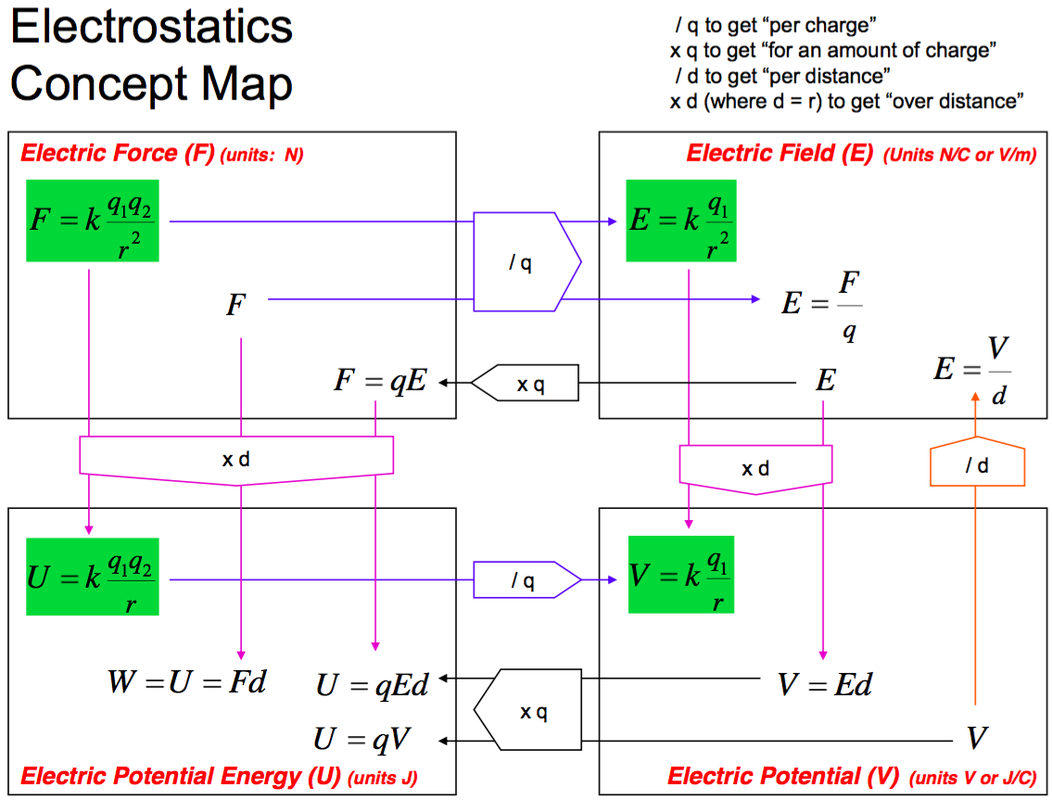
This seems like a semantic distinction, but it matters for how you solve problems. In Mechanics, you write F = ma. In Electrostatics, you write F = qE, where E is the field due to other charges. The field is an intermediary.
Once you accept this, the rest follows more naturally. But many students try to apply Mechanics intuition to Electrostatics problems and get confused.
The Formulas You Must Know
Core Electrostatics formulas:
- Coulomb's law: F = kq1q2/r² (force between two charges)
- Electric field of a point charge: E = kq/r²
- Field due to a dipole (axial): E = 2kp/r³ (far field)
- Field due to a dipole (equatorial): E = kp/r³ (far field)
- Electric potential of a point charge: V = kq/r
- Potential due to a dipole: V = kpcosθ/r²
- Electric flux: Φ = ∮E·dA
- Gauss's law: Φ = q_enclosed/ε₀
- Capacitance of a parallel plate: C = ε₀A/d
- Energy stored in a capacitor: U = ½CV² = ½Q²/C = ½QV
- Capacitors in series: 1/C_eq = 1/C1 + 1/C2 + ...
- Capacitors in parallel: C_eq = C1 + C2 + ...
That's about 12 core formulas. Not too many, but the applications get complex.
The Common Mistakes
Mistake 1: Confusing Field and Force
Field (E) is a property of space created by a source charge. Force (F) is what acts on a test charge placed in that field. They're related by F = qE, but they're not the same.
Students mix this up in two ways:
- Calculating the field due to a test charge (wrong — the test charge doesn't create a field, it responds to the field)
- Using q (the test charge) when calculating the field due to a source charge (wrong — the field depends only on the source charge and distance)
The rule: when calculating the field at a point, use only the source charge. When calculating the force on a charge at that point, multiply the field by the test charge.
Mistake 2: Sign Errors in Potential
Electric potential can be positive or negative, depending on the source charge's sign. A positive charge creates positive potential; a negative charge creates negative potential. When you sum potentials from multiple charges, the signs matter.
Students often treat potential as always positive, which leads to wrong answers in problems with mixed-sign charge configurations.
Mistake 3: Misapplying Gauss's Law
Gauss's law is always true, but it's only useful for calculation when there's symmetry (spherical, cylindrical, or planar). Students sometimes try to apply it to arbitrary charge distributions where it's true but not computable.
The rule: use Gauss's law when the charge distribution has symmetry. For arbitrary distributions, use Coulomb's law and integration (or superposition).
Mistake 4: Forgetting Field Lines Don't Intersect
Electric field lines start on positive charges and end on negative charges (or extend to infinity). They never intersect (because at the intersection point, there would be two field directions, which is impossible).
This is a conceptual point, but it comes up in multiple-choice questions. If you see a diagram with intersecting field lines, it's wrong.
Mistake 5: Dipole Field Distance Dependence
For a point charge, E is proportional to 1/r². For a dipole, E is proportional to 1/r³. Students sometimes use 1/r² for a dipole and get wrong answers.
The intuition: a dipole has two equal and opposite charges close together. At far distances, their fields nearly cancel (because they're almost at the same point), but not quite. The residual field falls off faster than 1/r², specifically as 1/r³.
Mistake 6: Capacitor Energy Formula Confusion
There are three equivalent formulas for capacitor energy: U = ½CV², U = ½Q²/C, and U = ½QV. They're all correct, but students sometimes use the wrong one for the given information.
The rule: if you know V and C, use ½CV². If you know Q and C, use ½Q²/C. If you know Q and V, use ½QV. They all give the same answer.
Mistake 7: Dielectric Effects on Capacitance
Inserting a dielectric of constant K into a capacitor multiplies the capacitance by K (so C_new = KC). The field inside decreases by K (if the capacitor is isolated, not connected to a battery). The energy changes depending on whether the capacitor is isolated or connected to a battery.
Students mix up these cases. The rule: if connected to a battery, V is constant, so energy increases (C increases, V constant then U = ½CV² increases). If isolated, Q is constant, so energy decreases (C increases, Q constant then U = ½Q²/C decreases).
How to Build Intuition
Electrostatics requires building a new kind of physical intuition. Here's how:
1. Always draw the field lines.
For any charge configuration, sketch the field lines. This helps you visualise the field direction and relative magnitude (denser lines = stronger field). Even rough sketches help.
2. Use symmetry.
In problems with symmetric charge distributions (spheres, infinite lines, infinite planes), identify the symmetry early. It tells you which direction the field points and which components are zero. Symmetry is your friend in Gauss's law problems.
3. Think about limiting cases.
If your formula for the field of a charged ring gives a finite value at the centre, that's correct. If it gives zero at infinity, that's correct. If it gives the point-charge formula at large distances, that's correct. Checking limits catches errors.
4. Use superposition.
For complex charge configurations, calculate the field (or potential) due to each charge separately, then add. Potential is easier (it's a scalar, just add magnitudes). Field is a vector (add components).
5. Solve the "classic" problems.
Certain problems recur in JEE: field on the axis of a charged ring, field of an infinite line charge, field inside and outside a charged sphere, potential due to a charged disc. Solve each of these once and understand the result. They appear repeatedly in different forms.
The Practice Strategy
For Electrostatics, I'd recommend:
- NCERT (Class 12, chapters 1-2) — read for concepts and basic formulas
- HC Verma (Part 2) — excellent for building intuition. The solved examples are gold.
- DC Pandey or Resnick Halliday — for practice problems
- Previous year papers (2015-2025) — to see how JEE frames questions
Realistic time budget:
- First-time learning: 30-40 hours
- Revision: 15-20 hours
- Last-month revision: 5-8 hours (formula sheet + quick problems)
The Connection to Other Chapters
Electrostatics is foundational for several later chapters:
- Current Electricity — builds on the concept of charge and potential
- Magnetic Effects of Current — analogous structure (magnetic field due to currents, like electric field due to charges)
- Electromagnetic Induction — combines electric and magnetic fields
- AC Circuits — extends DC concepts to time-varying signals
If you're weak in Electrostatics, you'll struggle in these later chapters too. Invest the time to build a solid foundation.
Final Thoughts
Electrostatics isn't the hardest chapter in JEE Physics (that honour probably goes to Rotational Motion or Modern Physics combined with Mechanics). But it's the chapter where conceptual confusion is most common — because the shift from Mechanics thinking to field thinking isn't always easy.
Slow down, understand the concepts, draw field lines, use symmetry. Don't try to memorise your way through — Electrostatics rewards understanding. Once you've built the intuition, the chapter becomes scoring rather than punishing. And the foundation pays dividends in every subsequent Electricity chapter.
Ready to put these strategies to work?
Examtro offers 30+ years of NEET and JEE previous year questions with instant evaluation and detailed analytics. Practice the way the real exam tests you.
Start practicing free →